
Self Publish With AI in 5 Steps From Draft to Launch
Overwhelmed by publishing, use AI to go from draft to launch in five steps, but one critical move will decide if you profit.
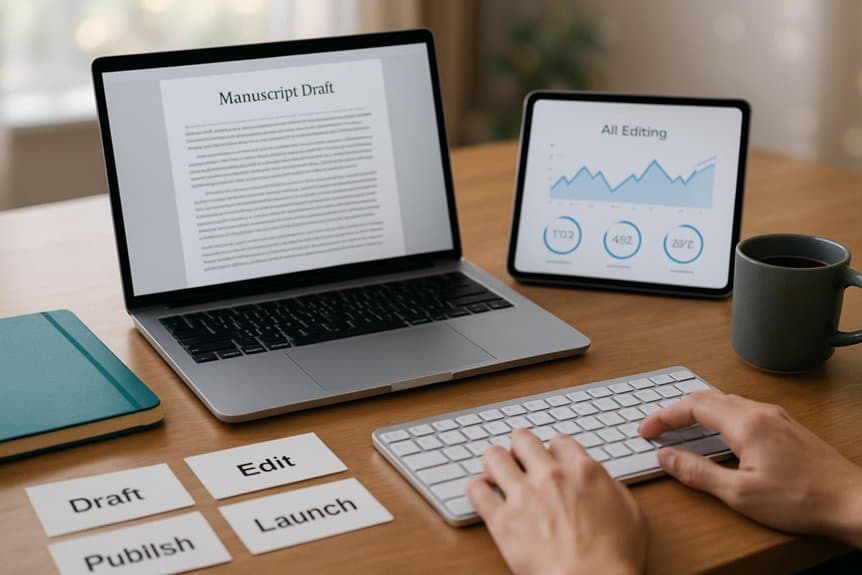
You can self-publish with AI in five steps: set a clear revenue goal, roles, and a deadline with buffer days; draft faster by feeding AI a chapter outline and tightening each section to keep your voice; run AI editing passes for grammar and structure, then hire a proofreader; format clean source files and export validated EPUB and print PDFs; publish wide with ISBNs, strong metadata, and AI-assisted launch emails and ads. Keep going to see each step.
Key Takeaways
- Set a revenue goal, define AI vs human roles, and build a timeline with milestones, buffer days, and biweekly reviews.
- Create a chapter outline, use AI for controlled-length drafts, then revise immediately to preserve your voice and consistency.
- Run AI grammar and structural passes, then hire a professional proofreader for a final context-aware sweep.
- Format with clean styles, export validated EPUB and print-ready PDF, and preflight files in Kindle Previewer and Acrobat before uploading.
- Publish wide with ISBNs, optimize metadata and keywords, and use AI-assisted marketing drafts with tracked emails, ads, and in-book lead capture.
Plan Your AI Self-Publishing Goals, Roles, and Timeline
Clarity turns AI self-publishing from a pile of tools into a plan you can execute. Start your self-publishing checklist by setting a measurable goal with a deadline (like $500/month in 12 months) and decide where AI writing tools supplement or replace work beyond drafting. Assign clear roles and responsibilities across writing prompts, editing (human plus editing tools), cover design (designer plus AI images), marketing, and production/distribution.
Next, build a timeline and milestones for pre-launch, launch week, and the 3-month post-launch: outline, developmental edit, cover mockups, formatting, metadata, pre-order setup, email sequence, and ads. Pick 1–2 marketing channels that fit your readers, budget weekly hours, add buffer days, and review progress biweekly. Include a short sprint plan that targets a focused draft and polish cycle to publish rapidly using weekend drafting techniques.
Draft Your Book Faster With AI (Keep Your Voice)
With your goals, roles, and timeline set, you can use AI to move from outline to first draft fast without letting the tool flatten your tone.
Start AI drafting by feeding a detailed chapter-by-chapter outline and requesting chapter expansion into 500–1,500-word sections.
Immediately revise each section so the AI text stays raw material, not final prose - this is voice preservation in action.
Use prompt engineering with explicit style cues (warm, witty first person, 12–15-word sentences, contractions) and prefer limited-output prompts like “3 options of 300–400 words.”
Mix dictation + editing: dictate an 800-word scene, run an AI clarity pass, then do one human sweep for pacing and voice.
Keep version control with Suggesting mode or snapshots to compare drafts and protect your phrasing.
Also build a simple story bible to track characters, rules, and timeline so AI drafts remain consistent. Consider using a Codex to store character and worldbuilding facts for long-term continuity.
Edit With AI, Then Hire a Human Proofreader
Once you’ve got a solid draft, run it through AI editing tools like Grammarly, ProWritingAid, or QuillBot to catch grammar slips, passive voice, repeated words, and readability snags before you pay a human. Use grammar checks in a few passes; in real editing workflow, that can cut copy-edit time by 20–40%.
Then run structural edits with Hemingway or targeted prompts to flag long sentences, weak transitions, and pacing issues, so a human can focus on meaning, not mechanics. Consider using templates from Jasper.ai to maintain a consistent voice across chapters and marketing copy.
After you’ve iterated, hire a professional proofreader for the final sweep. They’ll catch context errors, consistency glitches in names and dates, and subtle typos AI tools miss. Keep source files and edit logs, and disclose AI usage when required. Plan your editorial budget: reserve 25–40% for proofreading. A good starting point is to try PageWriter Studio’s 5-day free trial to turn your edited manuscript into a formatted book.
Format for eBook/Print + Prep POD Files
After the proofreader signs off, shift your attention to formatting, because clean files - not just clean prose - determine how your book reads on a Kindle and how it prints through POD. Build your source with styles (Heading 1 for chapters, consistent body, captions, quotes) so EPUB export keeps a reflowable layout and a clickable ebook TOC. For print, pick a genre-fit trim size (5″×8″ or 6″×9″), then set inside margins plus bleed and gutter to spec; start around 0.5″ gutters for slimmer books and increase with page count, and add 0.125″ bleed on full-bleed images. Export a validated EPUB and a print-ready PDF (PDF/X-1a) with embedded fonts and CMYK images. Preflight in Kindle Previewer/Acrobat, then upload to KDP/IngramSpark with matching interior and cover PDFs. Consider using AI tools for initial layout suggestions and consistency checks to speed production and catch basic formatting issues, especially when managing large manuscripts or multiple file types like DOCX and PDFs with robust file uploads. Also remember to document human edits and preserve prompt logs if you used AI-assisted drafting to help support copyright claims and platform disclosures.
Publish Wide: ISBNs, Metadata, and AI Launch Marketing
Before you hit “publish,” set your book up to sell beyond a single storefront by locking down ISBNs, metadata, and a launch plan you can scale with AI. Buy ISBNs from your regional agency (Bowker in the U.S., $125 for one, bundles cost less) so you own your listings and assign unique IDs to print, ebook, and audiobook.
For wide distribution, go direct where it matters (KDP, Apple Books, Kobo, B&N Press) and add aggregators like Draft2Digital or IngramSpark for libraries, bookstores, and global retailers. Nail metadata optimization: write a 150–350 word book description with a hook, add 7–8 keywords, choose two BISAC categories, and polish your author bio. Use AI launch marketing to draft emails/ads, then edit voice, check uniqueness, track CTR/CPA, and iterate. You can also create a simple in-book CTA and host an email bonus (checklist or editable template) on your site to capture leads and drive upsells to higher-priced PDF/workbook offerings like an Etsy or direct-sale bonus page.
Conclusion
You’ve got everything you need to self-publish with AI - without losing your voice. Set clear goals, split tasks between you and your tools, and stick to a timeline. Draft faster, edit smarter, then bring in a human proofreader to polish what AI can’t. Format clean files for eBook and print, prep POD, and publish wide with strong metadata and ISBN choices. Now launch with AI-assisted marketing and keep momentum.
Ready to write your book with AI?
Turn your idea into a finished, publishable book. Start your 5-day free trial today, no installation needed.
Start your free trialKeep reading

How to Find Profitable Keywords for Your AI Written Books
Meta: Master profitable keywords for AI-written books with proven tools and hidden gaps, then discover the crucial step most authors miss.

How to Publish an AI Book on Amazon KDP Step by Step
Unlock the step-by-step process for publishing an AI book on Amazon KDP, and discover the critical compliance details most authors miss.

How to Price Your AI Written Book for Maximum Profit
If you’re pricing an AI-written book, I’ll show you how to maximize profit without undercutting your sales strategy.